
Tech Museum of Time
A School-Based, Student-Curated Exhibition

Context & Learning Journey
This virtual Tech Museum of Time was created by a school class as part of an interdisciplinary learning experience that brings history, technology, art, and sustainability together. Guided by the Ages of Globalization framework, students explored how technological innovation has shaped human societies across seven historical ages—from the Paleolithic era to the Digital Age.
Working as researchers, designers, and storytellers, students investigated key inventions from their chosen age and translated their findings into original artworks and exhibition pieces using mixed media, recycled materials, and visual storytelling. The result is a student-curated museum that invites visitors to reflect on how technology responds to human needs, transforms societies, and raises new questions about sustainability, responsibility, and our shared future.
This exhibition is part of a broader STEAM-based lesson design that emphasizes systems thinking, creativity, and student agency. Visitors are invited to explore the artworks, follow the historical journey across the Ages, and reflect on how today’s technologies might one day be viewed through the lens of time.

Seven Ages, Seven Stories of Innovation:
A Virtual Exhibition
Paleolithic Age, 70,000–10,000 BCE
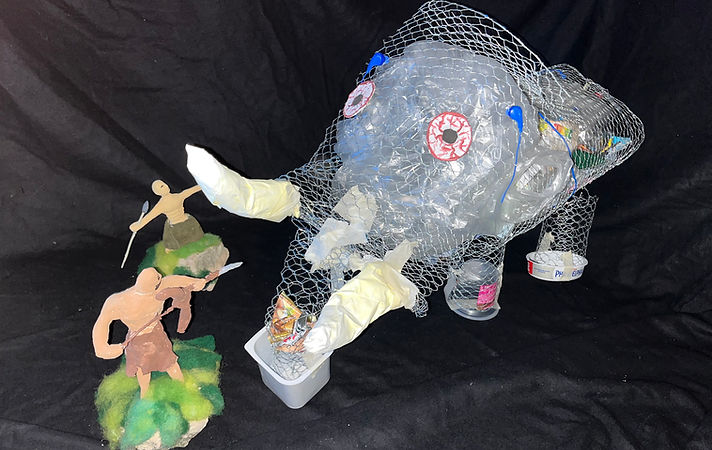
Artists: Valerio, Len, Ilayda
The Paleolithic Age was the first period of the Stone Age. It began around 2.5 million years ago and ended around 10,000 BCE. During this time, humans learned how to survive in a harsh world that was very different from the one we know today. The word Paleolithic means “old stone” and refers to the simple stone tools early humans used to survive.
During the Paleolithic Age, humans lived as hunters and gatherers. They survived by hunting animals such as fish and large land animals. In addition, they collected fruits, nuts, and roots for food. Because food sources changed with the seasons, Paleolithic people lived as nomads and moved from place to place. They slept in caves or in shelters made from wood and animal skins.
Hunting was a very important part of life during the Paleolithic Age. Early humans invented different hunting weapons, such as spears and bows made of wood and stone, which allowed them to attack animals from a distance. Over time, these weapons improved and became more effective, making hunting easier. Hunting tools also made it possible for humans to hunt in larger groups, which increased their chances of survival.
Today, humans no longer need to hunt for food. Instead, we buy food in supermarkets and throw the packaging into the trash. This shows how much human life has changed since the Paleolithic Age, even though hunting was the beginning of how humans learned to obtain food.
Neolithic Age, 10 000–3000 BCE

Artists: Henry, Jasmin, Paul
The Neolithic Age was the period in which humans began to settle down and form the first civilizations. This change was mainly caused by the discovery of agriculture, which made it possible to grow crops and improve them over time by selecting the best seeds. As a result, humans were no longer completely dependent on hunting for food.
Because food could now be produced in one place, people were able to settle permanently and build long-lasting shelters. They also began to domesticate animals, starting with dogs and later livestock such as sheep and cattle. These animals supported daily life by providing food, labor, and protection.
These developments were especially important because agriculture and animal domestication appeared independently in many different regions of the world at roughly the same time, rather than spreading from a single place. Settling down also made it possible for the first forms of government and social organization to develop, laying the foundation for the modern world. The silhouette of the modern world in the background creates a contrast and shows how far humanity has come and went away from their origins.
Equestrian Age, 3000–1000 BCE

Artists: Antonio, Christos, Panagiottis
The Equestrian Age (approximately 3,000–1,000 BCE) describes a period in history
in which the horse played a central role in military power, transportation, and social
organization. During this time, horses became a key factor in dominance and
mobility, especially in warfare.
This informal term largely overlaps with the scientific concept of the Eurasian Steppe
peoples. Cultures such as the Scythians, Huns, and later the Mongols used the
speed and mobility of horses to build large nomadic societies, dynasties, and
temporary empires. These horse-based cultures often threatened or ruled over
settled, agricultural societies in Europe and China.
The dominance of mounted warriors shaped warfare for thousands of years.
However, this supremacy eventually came to an end with the invention of firearms
and the rise of industrial warfare, which reduced the military importance of cavalry.
In our artworks, we used copper as the main metal to represent military dominance. Horses
made of copper symbolize their important role in transportation and warfare. We also tried to
show how many people lost their loved ones because of war, which led to the title: “I
survived, but what do I have to live for?” If we destroy our species through weapons, there will be nothing left to live for.
Classical Age, 1000 BCE–1500 CE

Artists: Laura, Eliza, Leonie, Jannes, Konstantin
The Classical Age spans from around 1000 BCE to 1500 CE and is marked by major developments in society, art, science, and technology. This period is represented by a marble track that symbolizes the flow of time. At its center stands a concrete aqueduct, which connects ancient and modern times and represents advanced engineering and an organized society. The marble track begins in yellow and changes to red, symbolizing the transition from simple structures and religious influence to technical progress, unrest, and power struggles.
The aqueduct marks a high point of ancient technology and the preservation of knowledge. After the aqueduct, the track continues in blue, representing knowledge, technology, and the future. As the marble speeds up and disappears at the end of the track, it illustrates that time continues to move forward without end.
Several symbols represent key developments of the era: a cross for the power of the Church, the alphabet for the beginnings of written knowledge, a book for the spread of knowledge through the printing press, and a coin for trade and the growth of cities. In summary, the model shows how society, knowledge, and technology have continuously developed and will keep progressing in the future.
Ocean Age, 1500–1800

Artists: Lena, Selma, Helena, Carmen
This wooden model ship represents the Ocean Age, a period defined by expanding horizons and the global exchange of goods (approximately 1500–1800). Inspired by the ships used during the voyages of Christopher Columbus, the model reflects the early stages of European exploration across the Atlantic.
During this global age, which began in the late 15th century, improved navigation techniques and advances in shipbuilding made it possible to travel farther than ever before. While this era greatly changed the European worldview, it also had devastating effects on Indigenous peoples, including cultural disruption, the spread of diseases, and forced labor.
As Columbus reached the Americas by accident, Indigenous peoples were deceived by his promises of “great friendship” and by gifts of little value. In reality, they were exploited for their resources, and their land was quickly occupied and taken from them.
The ship model therefore symbolizes both technological innovation and the encounters that shaped the modern world. It invites viewers to reflect on how the Ocean Age transformed global relationships and continues to influence them today.
Industrial Age, 1800–2000

Artists: Suen, Franziska, Carl, Lovis
The Industrial Age was the period from around 1760 to 1900, during which machines and factories replaced manual labor. This development led to mass production and rapid economic growth, but it also caused harsh working conditions, environmental pollution, and major social changes.
Our artwork depicts a map of Western Europe and Eastern North America. Industrialization began in Great Britain with inventions such as the locomotive and the rise of factories, which are represented in the artwork. Factories, which emerged around 1760, made production more efficient but also led to poor working conditions and serious social problems. This is symbolized by the factory placed in Sweden and Norway. The human figure trapped beneath the factory represents the difficult and oppressive conditions faced by many workers.
The locomotive, invented in 1804, was one of the most important innovations of industrialization. It enabled faster transportation and played a key role in economic growth. The car, invented in Germany in 1885, further transformed transportation and significantly influenced industrial development.
Finally, a computer is shown in the United States. Although computers were invented after the Industrial Age, they can be seen as a result of it, as industrialization encouraged innovation, mechanization, and technological progress. The computer therefore symbolizes how the Industrial Age continues to shape the present and the future.
The dead, black trees placed around each invention represent the negative environmental effects of industrialization and encourage viewers to reflect critically on its consequences.
In conclusion, the artwork illustrates how the Industrial Age shaped the modern world while also highlighting the serious problems it caused.
Digital Age, 2000–today
Artists: Vlada, Evi, Antonia, Sunghyun

The Digital Age describes the era in which digital technologies play a central and increasingly important role in the economy, communication, education, and everyday life. This age began around 1970 with the spread of computers and later the development of the internet, which fundamentally changed how people access and share information.
Digital progress makes it possible to spread information quickly and efficiently across the entire world. News, knowledge, and ideas can now be shared within seconds, something that was unimaginable in the past. As a result, people are more connected than ever before.
Digitalization has fundamentally changed everyday life. Today, people can shop online, work from home, and communicate easily with others around the world, regardless of distance. Through video calls, social media, and messaging services, individuals can stay in contact with family, friends, and others worldwide.
Modern technologies such as artificial intelligence also play an important role in many areas, including medicine, education, and industry. Digitalization affects almost every aspect of life and has become an essential part of modern society.
Artificial intelligence is now deeply integrated into everyday life and is even capable of replacing humans in certain fields, including artistic ones. This raises important questions about the future of human creativity and reminds us that, as humans, we should not allow technology to fully replace us.
Today, we live in the most technologically advanced world in history and benefit greatly from medical and scientific progress. The computer made from simple materials creates a strong contrast to the highly advanced Digital Age. While modern technology represents precision and innovation, the basic materials highlight the contrast between simplicity and the most developed era of human history.


Student Curators & Creators
This exhibition was initiated and brought to life by a group of students and their teacher at the Wilhelms-Gymnasium, Stuttgart, Germany working with the Ages of Globalization framework as their guide and the world's technological history as their raw material.
In their own words:
"I enjoyed learning about my age in history. It was a very creative way to teach the different ages of globalization."
"The project was fun and we learned a lot about the different ages. It was very creative because we had to come up with own ideas and find ways to express them."
"I liked to try different materials and methods to express my ideas. It showed me our ability to build bridges up again after they collapsed and how to manage the material - a lot of try and error and fun."
.png)
Integrating Ages of Globalization into my art curriculum challenged students to engage critically with global issues and translate them creatively into the present day. The global framework offered new perspectives for both my students and me, making this a deeply enriching teaching and learning experience.
Dorothea Müller, Art & German Language Teacher
The Making of the Tech Museum of Time
